
Request Research-Grade 4H-SiC Wafers
Need 4H-SiC wafers for high-voltage or RF research? Tell us your diameter, type (N-type or semi-insulating), off-axis angle, and resistivity requirements and we’ll respond quickly.
Get Your Quote FAST! Or, Buy Online and Start Researching Today!
Common request fields:
Diameter, polytype (4H), conductivity (N-type or semi-insulating), off-axis angle, thickness, resistivity or carrier concentration, surface finish (epi-ready).
4H-SiC for High-Voltage Research
Related SiC Research Resources
- 4H-SiC Wafers for Power and RF Applications
- Silicon Carbide (SiC) Wafers Overview
- SiC Wafer Manufacturing and Quality Control
- Undoped Silicon Wafers for Early-Stage Research
4H-SiC Wafers for High-Voltage Research: Materials, Specs, and Practical Guidance
For high-voltage and high-frequency research, 4H-SiC wafers have moved from a niche option to a default substrate in many US labs and pilot fabs. With breakdown fields often cited around 2.2 MV/cm, 4H-SiC enables experiments and prototype devices that are not practical on traditional silicon wafers. At the same time, lead times, domestic support, and sourcing routes increasingly matter alongside resistivity and crystal quality.
Key Takeaways
- Why 4H-SiC: Wide bandgap, high breakdown field, and strong thermal conductivity for compact high-voltage and RF devices.
- Choose your substrate: N-type for conductive power structures, semi-insulating for RF isolation and low-leakage test structures.
- Specs drive yield: Off-axis angle, micropipe density, thickness and resistivity uniformity, and epi-ready polish impact results.
- Plan sourcing early: US lead times, logistics, and procurement requirements can be just as important as the datasheet.
1. Why 4H-SiC Matters for Next-Gen High-Voltage Research in the US
4H-SiC has become a workhorse wide-bandgap material for high-voltage, high-frequency, and high-temperature experiments across US universities, national labs, and advanced fabs. Its combination of wide bandgap behavior, high breakdown capability, and good thermal performance helps researchers push voltage and power density beyond what silicon wafers can support.
2. Core Material Benefits for High-Voltage and RF Work
For kV-class device research, 4H-SiC supports thick, lightly doped drift regions while keeping on-resistance within usable ranges for many architectures. Thermally, 4H-SiC removes heat more effectively than silicon, which is especially helpful for demanding switching losses and elevated ambient temperatures. For RF and mm-wave experiments, polytype quality and defect control strongly influence performance and repeatability.
3. Key Wafer Types: N-Type vs Semi-Insulating 4H-SiC
N-Type 4H-SiC (Conductive)
N-type 4H-SiC provides a controlled conductive path and is commonly used for power diodes, MOSFETs, Schottky devices, and other vertical or high-field structures. It’s also a practical choice for process development and “dummy” runs before committing to premium lots.
Semi-Insulating 4H-SiC
Semi-insulating 4H-SiC behaves like an electrical foundation with very high resistivity, making it useful for RF isolation, device separation, and mixed high-voltage plus RF test structures. If your project depends on minimizing leakage and coupling, semi-insulating substrates are typically the right starting point.
4. Diameter, Off-Axis Cuts, and Specs That Matter in US Labs
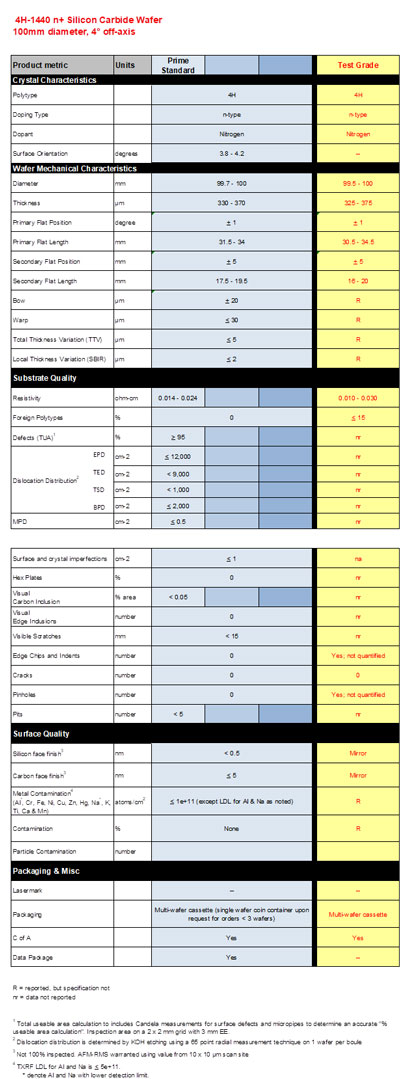
Many US research groups still use 2-inch, 3-inch, and 4-inch 4H-SiC wafers, while 150 mm and 200 mm are increasingly relevant in pilot-line work. For high-voltage design and yield, the following parameters typically have outsized impact:
- Off-axis angle: Often specified around 4° to 8° to support epitaxy and reduce defect-related issues.
- Micropipe density (MPD): Lower MPD is generally preferred for sensitive high-field structures.
- Surface finish: Epi-ready polish and low roughness on the Si-face matter for MOS interfaces and RF gates.
- Uniformity: Thickness and resistivity uniformity influence repeatability across the wafer and across lots.
For background on SiC polytypes and processing flow, see: Silicon Carbide (SiC) Wafers Overview and SiC Wafer Manufacturing: Polytypes, Growth, and QC.
5. Moving From Silicon Wafers to 4H-SiC: What Changes in Your Research Flow
Switching from silicon to 4H-SiC changes more than the substrate. Etch recipes, thermal budgets, oxidation behavior, and handling considerations may need adjustment due to SiC’s hardness and different materials response. However, the overall cleanroom workflow remains familiar: deposition, lithography, etch, and metrology.
A common approach is to prototype early ideas on silicon test vehicles, then transfer promising designs onto 4H-SiC for high-voltage and high-temperature validation. For low-cost silicon test wafers, see Undoped 1" Silicon Wafers.

6. US-Focused Supply and Procurement Considerations
US research groups often balance crystal quality and specifications with practical procurement factors like lead time, domestic support, documentation, and receiving processes. For non-standard needs such as unusual off-axis angles, very high resistivity ranges, or specific polishing requirements, it helps to define specs clearly up front so quotes and timelines are realistic.
7. Cost Planning for High-Voltage SiC Projects
In high-voltage research, wafer cost is only part of the total cost of ownership. Budgeting should also reflect shipping, receiving logistics, and the number of wafers needed for iterations. A practical strategy is to start with a small lot to validate the process, then scale to larger or premium lots once device architecture and yield drivers are understood.
8. Application Focus: Power, RF, Photonics, and Beyond
4H-SiC is used broadly across power electronics, RF/mm-wave, isolation structures, and emerging photonics platforms. N-type substrates commonly anchor power devices and high-field test structures, while semi-insulating 4H-SiC supports isolation and RF designs where low leakage and reduced coupling are critical.
9. Practical Buying Guide for US Researchers
When preparing a purchase request, start by specifying: diameter, polytype (4H), conductivity (N-type or semi-insulating), off-axis angle, and any minimum resistivity or carrier concentration requirements. For high-voltage work, also include your target defect limits (such as MPD) and whether you require epi-ready polishing.
- Order a small lot of standard wafers to validate cleaning, etch, and lithography flow.
- Lock down the critical specs that affect breakdown and yield (off-axis, surface finish, defect limits, uniformity).
- Reserve premium or highly customized wafers for final device runs rather than early learning cycles.
10. Looking Ahead: Larger Diameters and Next-Gen Platforms
US high-voltage research is closely tied to scaling 4H-SiC wafer diameters while maintaining defect control and uniformity. The more your team learns now about handling, process windows, and electrical behavior on 4-inch and 6-inch wafers, the better prepared you’ll be for future pilot-line and production platforms.
Conclusion
4H-SiC wafers provide a practical, future-ready platform for high-voltage, high-frequency, and high-temperature experiments that outgrow traditional silicon. By choosing the right substrate type (N-type vs semi-insulating), specifying the wafer parameters that drive yield, and planning procurement realistically, US research teams can build a more resilient roadmap from early prototypes to validated high-voltage hardware.