
What is the Most Common Quartz Cut?
It can be hard to know which type of single crystal quartz wafer is right for your needs. There are many different types available, each with its own unique benefits and drawbacks.
AT-Cut Single Crystal Quartz Wafers are some of the most versatile available. They can be used in oscillators and filters, making them perfect for a wide range of applications. However, they are also very brittle, so it's important to use a wafer carrier when working with them.
UniversityWafer, Inc. AT-Cut Single Crystal Quartz Wafers are the most widely used type of quartz crystal. These wafers have the highest temperature coefficient and are suitable for high-frequency applications. They are commonly used in electronic equipment, resonators, and oscillator devices. In fact, a majority of electronic devices rely on quartz wafer substrates for precise frequency control. The wide range of applications means that AT-Cut Quartz Wafers can be used in many fields.
Get Your Quote FAST! Or, Buy Online and Start Researching Today!
AT-Cut Quartz Applications
Microphone - The use of AT-cut single crystal quartz wafers for microphones has become a popular choice due to their excellent ability to operate at high frequencies. Using ultrasonic waves as carriers, these devices are able to achieve extremely high bandwidth and sensitivity. With the addition of a directional coupler, they can be tuned to the desired frequency. The addition of a second carrier can increase the bandwidth by a factor of three, and consequently increase the signal-to-noise ratio (SN/PI) of the microphone.
Vibration Analysis - One can simulate a large number of vibration states using a single crystal quartz substrate and a random background. One of the advantages of using AT-cut crystal blank is that it is inherently multi-frequency sensitive. For example, if one puts a voltmeter on a piece of graph paper and places a series of capacitors on it, one can generate a number of sinusoscaled voltage fields with varying waveform and amplitude. The resulting signals are then shown on a plot (a displacement map) by the method described above. This method can also be used to simulate an electric field that is parallel to the crystal lattice.
Densitometry - This technique uses a series of AT-cut quartz wafers to obtain densitometry information on the electrical properties of a piece of material. The product characteristics can be found on the basis of the dimensions of the various interfaces. Various modeling techniques and analytical software are used to derive the electrical resistivity, density, porosity, sheath thickness, dielectric strength and hardness of the material. This method is ideal for analyzing non-porous materials like ceramics and stainless steel.
Structural Analysis - The measurement of structures is an important part of materials science research. It is useful in the areas of bending, compressive stresses, tensile strength and strain relief. In many cases, stiffness is not directly proportional to bulk thickness; however, the principle of governing tensile strengths by using AT-cut quartz crystals is also applicable to thin films and thin layers. Various parameters can be measured to evaluate structural thickness including porosity, density, hardness, slip resistance, grain boundary, grain size and hardness. Some other important parameters that can be determined with the help of AT-cut quartz crystals include tensile strength, moments of instability, critical points, and compressive bending loads.
Circuit Testing - During testing, it is necessary to control the operating potentials of the device under test. For this purpose, a number of different parameters can be used like current-voltage measurements and time-averaged changes in voltage across terminals. The frequency of operation of terminals can also be evaluated in relation to the quartz crystal wafer characteristics of interest. Generally, terminals are tested at the lowest possible current setting while maximum voltage is maintained across the terminals.
Product Analysis - This technique evaluates the mechanical properties of a device. The evaluation is done through tensile testing or mechanical stress testing. The process of product analysis begins with the identification of the crystalline structure of the product being tested. Different aspects such as impurity formation, crystal lattice structure, distortion and additive manufacturing effects can be studied to determine product characteristics. These aspects can then be compared with the expected behavior of the single crystal quartz structure during the experimental procedure.
Crystal Blanking - It is another popular technique of quality testing using AT-cut quartz crystal blanks. For this process, a very small amount of the crystal blank is passed through quartz crystal wires to form the crystal blanks. Electric potentials are then observed between the areas where the wire is passed through. If discontinuous changes in electric potential appear at these points, the crystal blanks have been successfully bypassed. Some unique characteristics of AT-cut quartz wafers can only be identified when the actual sample characteristics are analyzed.
Why AT-Cut Quartz Used in Electronics Video
Related Quartz and Crystal Substrates
What Applications Use AT-Cut Quartz?
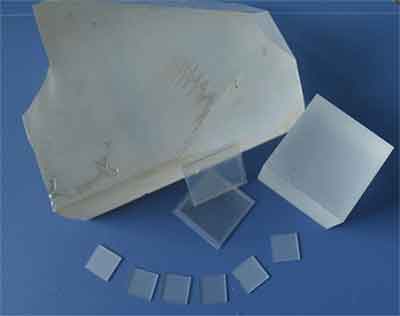 The AT-Cut Single Crystal Quartz Wafer is the best choice for your requirements. Its transparent nature makes it ideal for the creation of a hologram and other electronic components. The X-Cut Single Crystal Quartz Wafer is an ideal choice for optical systems. Its superior electrical and mechanical properties make it a top choice for the semiconductor industry. It is often used for ultra-high-end devices.
There are many different types of quartz wafers available. Some were developed decades ago, but have now fallen out of popularity because of the newer and more advanced processes. The AT-Cut Single Crystal Quartz Wafer is a very versatile material, with the ability to be used in oscillators and filters. The only drawback is its brittleness, making it necessary to use a wafer carrier.
Just Some AT-Cut Quartz Inventory that We Have in Stock
| Angle | Diameter | Polish | Flat | Seed |
|---|---|---|---|---|
| AT36°-cut | 50.8*0.5 | DSP | 16mm | withseed |
| AT36°-cut | 76.2*0.1±0.05 | DSP | 22mm | withseed |
| AT36°-cut | 76.2*0.35 | SSP | 22mm | seedless |
| AT36°-cut | 76.2*0.5 | SSP | 22mm | seedless |
| AT36°-cut | 100*0.1±0.05 | DSP | 32mm | withseed |
| AT36°-cut | 100*0.35 | SSP | 32mm | seedless |
| AT36°-cut | 100*0.5±0.02 | SSP | 32mm | seedless |
AT-Cut Single Crystal Quartz Wafer products are available in a wide range of sizes. The AT-Cut Single Crystal Quartz Wafer has a high purity and Q value and is used for microwave frequency control. These single-crystal quartz wafers are also popular in the radio and television industries. The thin thickness of the crystal makes it suitable for use in microwaves. This is a great benefit for customers in the wireless communications industry.
How Long Have AT-Cut Quartz Been Around?
AT-Cut Single Crystal Quartz Wafers have been found to have excellent properties for microwave filters in wireless communication industries. In addition, the single crystal quartz wafer has been used for more than 40 years. Its excellent thermal conductivity makes it the ideal choice for a variety of applications.
What is AT-Cut Quartz Single Crystal?
The AT-Cut process is one of the most advanced methods used for producing single crystal quartz substrates. It is a specialized cutting process that enables the production of high-quality crystalline quartz. This quartz wafer has many unique characteristics such as high corrosion resistance and excellent optical transmittance. It also has excellent thermal conductivity and high working and melting temperatures, making it ideal for use in manufacturing and electronic equipment.
AT-Cut Single Crystal Quartz Wafers are hydrothermal-grown, high purity quartz. The wafers have excellent thermal conductivity, high working temperature, good optical transmittance, and a unique piezoelectric property. Because of these properties, these quartz wafers are highly suitable for use in the semiconductor industry. These quartz wafers are available in diameters of 2 inches, 3 inches, four inches, and six inches. They can be polished on only one side or both sides.
UniversityWafer, Inc. distributes AT-Cut Single Crystal Quartz Wafer substrates in 150 mm. These thin-slice single crystal quartz wafers are 0.5 mm thick and can be manufactured in many diameters and thicknesses. With its wide array of options, UniversityWafer can meet nearly all of your quartz wafer needs.
AT-Cut Single Crystal Quartz Wafer possesses excellent optical quality and high thermal conductivity. Moreover, it has high corrosion resistance and a high working temperature. It is brittle, requiring wafer carriers for packaging. Therefore, UniversityWafer is a good choice for clients who need a wide range of sizes and specifications.
How does a Quartz Oscillator Work?
Quartz crystals have established themselves as precise frequency generators, but how does a thin quartz disk determine the heartbeat of an application? Quartz crystals work by determining the angle between the quartz crystal wafers, which determines their exact frequencies as generators.
It sounds simple, but it is very complex because not all quartz blanks are the same and every quartz blank is different. The ambient temperature changes slightly, so does the frequency of the desired signal. This affects the stability of the frequencies produced by the quartz and can cause the temperature to change more, which in turn can lead to further frequency changes.
Quartz crystals also differ in their oscillations, but not as much as other types of quartz blanks. They act like bow tendons, alternately tensed and relieved, and the longitudinal oscillator stretches its longitudinal axis as if stretched by a rubber band.
The most common type of oscillation is the thick shear oscillator, where the quartz disk changes its thickness during vibration.
How do you Make Quartz Vibrate?
AT-Cut Vibration Type and Temperature Coefficient Defined
Cutting quartz crystals based on mathematical calculations and removing the quartz disk from the crystal is crucial for producing quartz oscillator wafers. These changes can significantly affect the quality of the component and must be carefully controlled during production.
One of the most common angle cuts is the AT-cut, which is created at a specific angle relative to the center of the quartz crystal. Quartz blanks produced in this way have a good temperature coefficient, and the AT-cut is one of the most frequently selected orientations for frequency control devices.
How to Make Quartz Vibrate
To make quartz vibrate, fine electrodes must be attached to the quartz crystal. However, quartz crystals are passive components and require an external voltage to function.
The thin metal electrodes are deposited on the quartz surface, and the crystal blank is carefully processed to ensure uniform thickness and stability. This process determines the mechanical properties and frequency characteristics of the quartz resonator wafer.
Quartz Temperature Vs. Frequency
The frequency variation (FV) performance is measured in parts per billion (ppb), and different quartz cuts provide different oscillator performance levels. Frequency and temperature stability describe how the frequency output of an oscillator changes with temperature.
Compared to other quartz cuts, AT-cut quartz provides good stability over a wide temperature range, which is why AT-cut quartz wafers are widely used in electronic timing devices.
Quartz Crystal Aging
The aging of a quartz crystal is usually caused by impurities in the oscillator structure. Aging is typically measured in ppb and can affect the long-term stability of quartz oscillators and frequency control devices.
What is G-Sensitivity?
G-Sensitivity describes the sensitivity of an oscillator to acceleration, vibration, and environmental factors. A quartz crystal wafer is an electromechanical device that vibrates when voltage is applied. The electrical output characteristics change when mechanical forces affect the oscillator.
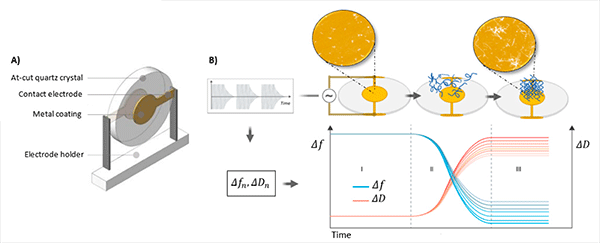
AT-Cut Quartz Microprocessor
In the early 1990s, AT-cut quartz crystal microprocessors were introduced as an improved alternative to standard mechanical microprocessors. The AT-cut crystal made use of a unique microdomain with only two working directions. This feature allowed AT-cut crystal logic elements to scale processing capability and enabled new electronic applications.
AT-Cut Quartz Inventory
We have the following in stock. The inventory changes daily. Please let us know what specs work for you?
| Diameter | Ori | Thickness | Pol | Brand /Grade | TTV | Rougness Front | Back |
|---|---|---|---|---|---|---|---|
| 50.8+/-0.2mm | Z-CUT | 0.1mm+/-0.03mm | DSP | SAW | <10um | ||
| 50.8+/-0.2mm | Z-CUT | 0.15+/-0.01mm | DSP | SAW | <10um | ||
| 50.8+/-0.2mm | Y-CUT+/-10' | 200 ±15um | DSP | SAW | <10um | ||
| 50.8+/-0.2mm | Z-CUT | 0.2mm±0.03mm | DSP | SAW | <10um | ||
| 50.8+/-0.2mm | Z-cut | 0.3 +/-0.02mm | DSP | SAW | <10um | <1nm | <1nm |
| 50.8+/-0.2mm | Z-cut | 0.35 +/-0.02 mm | DSP | SAW | <10um | <1.2nm | <1.2nm |
| 50.8+/-0.2mm | Z-CUT | 500±25um | DSP | SAW | <10um | ||
| 50.8+/-0.2mm | X-Cut | 0.5 ±0.025mm | DSP | SAW | <10um | <1nm | <1nm |
| 76.2+/-0.2mm | AT-cut | 0.1mm+/-0.03mm | SSP | SAW | <10um | <1nm | GC#1000 |
| 76.2+/-0.2mm | AT-CUT | 0.35+/-0.02mm | DSP | SAW | <10um | <1nm | <1nm |
| 76.2+/-0.2mm | X-Cut | 0.5+/-0.02mm | DSP | SAW | <10um | <1nm | <1nm |
| 76.2+/-0.2mm | ST-cut | 500± 25 um | DSP | SAW | <10um | ≤ 10A | ≤ 10A |
| 76.2+/-0.2mm | AT-CUT | 500± 25 um | DSP | SAW | <10um | ≤ 10A | ≤ 10A |
| 100+/-0.2mm | Y-Cut±15′ | 0.1 +/-0.03mm | DSP | SAW | <10um | ||
| 100+/-0.2mm | AT-Cut | 100+/-25μm | DSP | SAW | <10um | <1nm | <1nm |
| 100+/-0.2mm | Z-CUT | 0.1mm+/-0.03mm | SSP | SAW | <10um | ||
| 100+/-0.2mm | X-Cut | 200 ± 25μm | DSP | SAW | <10um | <1nm | <1nm |
| 100+/-0.2mm | Z-Cut ± 0.5° | 0.2± 0.025mm | SSP | SAW | <10um | ≤ 10 A | GC#1000 |
| 100+/-0.2mm | Z-Cut | 300 ±10µm | DSP | SAW | <10um | <1nm | <1nm |
| 100+/-0.2mm | X-Cut | 300 ± 25μm | DSP | SAW | <10um | <1nm | <1nm |
| 100+/-0.2mm | AT-Cut | 0.35 mm± 0.03 mm | DSP | SAW | <10um | <1nm | <1nm |
| 100+/-0.2mm | 42.75st-CUT | 350μm | DSP | SAW | <10um | <1nm | <1nm |
| 100+/-0.2mm | X-Cut | 0.5± 0.025mm | DSP | SAW | <10um | <1nm | <1nm |
| 100+/-0.2mm | Y-cut | 0.5 +/-0.025mm | DSP | SAW | <10um | < 1nm | < 1nm |
| 100+/-0.2mm | Z-cut | 0.5 +/-0.03mm | DSP | SAW | <10um | <1nm | <1nm |
| 100+/-0.2mm | ST-CUT | 0.5+/-0.025mm | DSP | SAW | <10um | ||
| 100+/-0.2mm | AT-Cut | 0.5+/-0.025mm | DSP | SAW | <10um |