
Just looking for some polished CZ wafers, 3" diameter x 1/4" thickness. We’re going to be coating these with mirrors, so as long as they’re well-polished (flatness < λ/10 @ 632nm, roughness < 5 Angstrom RMS), they’ll be good enough for us.
Silicon Mirror With Excellent Surface Roughness (RMS)
A materials engineer requested a quote for the following:
UniversityWafer, Inc. Quoted
tem Qty. Description
CO36. 10/25 Silicon wafers, per SEMI Prime, P/E 3"Ø×6,350±50µm, (1/4") n-type Si:P[111]±0.5°, Ro=(1-100)Ohmcm, can accept p-type
One-side-polished, back-side Alkaline etched, SEMI Flats (two),
Roughness<5A RMS. Sealed in Individual Wafer cassette.
Reference #150785 for specs and pricing.
Get Your Quote FAST! Or, Buy Online and Start Researching Today!
Related Silicon Surface Quality Resources
Silicon Mirror With Excellent Surface Roughness (RMS)
A materials engineer requested a quote for the following:
Just looking for some polished CZ wafers, 3" diameter x 1/4" thickness. We’re going to be coating these with mirrors, so as long as they’re well-polished (flatness < λ/10 @ 632nm, roughness < 5 Angstrom RMS), they’ll be good enough for us.
UniversityWafer, Inc. Quoted
Item Qty. Description
CO36. 10/25 Silicon wafers, per SEMI Prime, P/E 3"Ø×6,350±50µm, (1/4") n-type Si:P[111]±0.5°, Ro=(1-100)Ohmcm, can accept p-type
One-side-polished, back-side Alkaline etched, SEMI Flats (two),
Roughness<5A RMS. Sealed in Individual Wafer cassette.
Reference #150785 for specs and pricing.
Get Your Quote FAST! Or, Buy Online and Start Researching Today!
How Do You Measure The Surface Roughness of Silicon Wafers?
Surface roughness of silicon wafersis a critical parameter in semiconductor manufacturing, affecting the quality and performance of the final semiconductor devices. It's measured using several techniques, each with its advantages and specific applications. Here are the primary methods used for measuring the surface roughness of silicon wafers:
-
Atomic Force Microscopy (AFM): AFM is a high-resolution scanning probe technique that provides
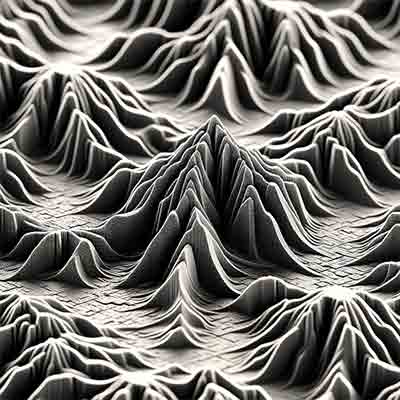 topographical data of the surface at the nanometer or even atomic scale. A sharp tip on a cantilever scans across the wafer's surface, and the deflection of the cantilever due to the surface topology is measured. AFM is highly accurate and can measure very fine surface features, but it's relatively slow and typically covers small areas.
 -
Optical Profilometry: This non-contact method uses light to measure the surface topography. There are various optical profilometry techniques, such as white light interferometry and laser scanning confocal microscopy. These methods project light onto the surface and analyze the reflected light to determine surface roughness.
-
Stylus Profilometry: In this method, a diamond-tipped stylus is mechanically moved across the wafer surface. The vertical movements of the stylus, as it tracks the surface topography, are recorded to measure roughness.
-
Scanning Electron Microscopy (SEM): SEM provides high-resolution images by scanning the surface with a focused beam of electrons. While SEM is primarily used for imaging, the images can also be analyzed to estimate surface roughness.
-
X-ray Reflectivity (XRR): XRR is a non-contact, non-destructive technique used to measure the density, thickness, and roughness of thin films on silicon wafers.
Why is Measuring Silicon Wafer Roughness Important?
Checking the texture of silicon wafers is key. The importance of surface roughness measurement can be understood through its impact on the following aspects:
-
Device Performance: Surface roughness can significantly affect the electrical properties of semiconductor devices.
-
Thin Film Adhesion: Many semiconductor device manufacturing processes involve the deposition of thin films on silicon wafers.
-
Photolithography Quality: Surface roughness can affect the quality of photolithography by causing defocus or distortion of the pattern.
-
Optical Properties: For devices that rely on optical properties, such as LEDs, lasers, and photovoltaic cells, surface roughness can influence the efficiency of light absorption and emission.
-
Reliability and Yield: Surface defects and irregularities associated with high surface roughness can be initiation sites for crack propagation and other failure mechanisms in semiconductor devices.
-
Process Control and Optimization: Measuring surface roughness is an important tool for process control and optimization in semiconductor manufacturing.